
Top Signs You Need Air Duct Cleaning Service – Don’t Ignore These
The signs people search for online are often the wrong ones. Dust on a register grille usually means your filter isn’t capturing particles well, which is a filtration or airflow problem, not proof your duct walls are dirty. Real duct contamination shows up differently, and each symptom points to a specific fix. Knowing which is which keeps you from paying for a cleaning when you actually need a repair, a coil service, or a better filter.
We’d rather you call us for the right reason than the wrong one. If reading this feels like more homework than you want, just call (855) 526-8990 and we’ll help you sort it out.
Key Takeaways
- Visible dust settling on vents is usually a filter problem, not a duct contamination problem.
- Uneven room temperatures more often point to a leak, disconnection, or restriction than to dirty duct walls.
- Rising energy bills and longer run times are late-stage signs, not early warning ones.
- A flashlight and a clean white cloth can tell you a lot before anyone comes out.
Which Signs Actually Point to Dirty Ducts?
Genuine dirty-duct signs come from inside the system: a musty or stale smell that returns shortly after you clean a room, a visible dark film building on the inside of the return grille, or debris blowing out of a supply register when the blower starts. Those point to contamination the air is actually moving through.
Other signs get blamed on dirty ducts but usually have a different cause:
- Dust coating the outside of the grille points to filtration failure. The filter isn’t catching particles, so they settle on the nearest surface.
- Uneven temperatures between rooms points to duct leakage, a disconnected run, or a restriction, not to dirty duct walls.
- A musty smell that stays even when the system is off often points to a dirty evaporator coil or a moisture problem, not the ducts alone.
- Rising bills and long run times point to airflow loss, which can come from a crushed or leaking duct or a clogged coil.
The practical takeaway: a thorough inspection should tell you which of these you have before any work starts. A company that quotes a cleaning without looking at the coil, the return side, and the duct runs is guessing. We’d rather diagnose first and tell you the truth about what’s going on.
Why Anaheim Hills Homeowners See Signs After Wind Events and Fires
Anaheim Hills sits where dry, fast wind events push a lot of particulate into the air, and some of it finds its way into return ducts through whatever gaps exist. If you notice a fresh layer of dust settling indoors in the days after a windy stretch, and it keeps returning after you wipe surfaces, that’s worth looking into rather than ignoring.
The second local trigger is smoke odor. After a regional fire, smoke particles can linger in ductwork and insulation long after the air clears outside, and a standard vacuum at the register won’t pull them out. When odor hangs around indoors while the outdoor air smells clean, that’s a sign the system is holding onto something.
The third is humidity. A sharp indoor humidity spike with no weather explanation often means attic air is finding a path into your ductwork through a gap or a poorly sealed joint. That’s a duct-sealing problem, and it’s why cleaning and sealing work best as a pair. If the ducts aren’t closed up after they’re cleaned, the next windy week undoes the work.
Local climate is mild here, so frozen-pipe and salt-air concerns don’t apply. The real Anaheim Hills issues are dryness, windborne dust, fire-season smoke, and the occasional infiltration through gaps in the system.
What Uneven Room Temperatures Are Really Telling You
If one room runs warm in summer and cold in winter while the rest of the house is comfortable, dirty duct walls are rarely the cause. That pattern usually points to a duct restriction, a disconnected run, or leakage somewhere along the path to that room.
Here’s how to think about it:
- One room off, rest fine: suspect the run serving that room. It may be crushed, disconnected, or leaking before it reaches the register.
- Whole floor off, others fine: suspect the main trunk or a damper issue.
- All rooms weak on airflow: suspect a clogged filter, a dirty evaporator coil, or a blower problem before you suspect the ducts.
- Airflow fine but air smells off: this is the one that most often does point to contamination inside the ducts.
We’ve seen plenty of cases where a homeowner expected a cleaning and the real fix was sealing a few joints and a disconnected run. Duct repair and sealing closes that loop and keeps the system from re-contaminating itself right after a clean.
Why Higher Bills and Longer Run Times Come Late, Not Early
Increased HVAC run times and higher energy bills are a late-stage signal, not an early one. A duct system loses efficiency gradually as contamination builds, airflow drops, and the blower has to work longer to move the same air. By the time you notice it on your bill, the problem has usually been building for a while.
The rough progression looks like this: first, particles collect and filter performance drops. Then airflow restricts across the coil, and the system runs longer to keep up. Then the coil itself begins to collect debris, which compounds the blockage. Only after all of that does the energy impact become obvious to a homeowner.
This is why we don’t lead with “clean your ducts to save energy.” The more useful framing is: if you’re already seeing longer run times, the system has been running inefficiently for a while, and it’s worth a real inspection. Clearing contamination and closing leaks restores airflow, and restored airflow is what the efficiency number actually reflects.
The full picture includes supply and return ducts, the HVAC unit, and the dryer vent, all handled together. If you want to understand what a full service looks like, take a look at HVAC cleaning alongside duct work.
How to Check Your Own Ducts Before Calling Anyone
You can do a genuinely useful self-check with a flashlight and a clean white cloth. The point isn’t to diagnose the system; it’s to gather enough evidence to know whether a call is warranted, and what to ask about.
Here’s what we suggest:
- Wipe the inside of a return grille with the white cloth. A little gray dust is normal. A thick dark film or visible debris that smears is worth a look.
- Hold the flashlight inside a supply register and look up the run. You’re checking for heavy buildup on the duct walls, not for a light dusting.
- Check the filter. If it’s loaded, replace it and see whether your dust and airflow complaints improve over a week or two.
- Run the system and feel airflow at each register. Weak registers reveal leaks and restrictions that a cleaning won’t fix.
- Notice odor. If a musty smell returns within days of airing a room out, that’s a sign worth acting on.
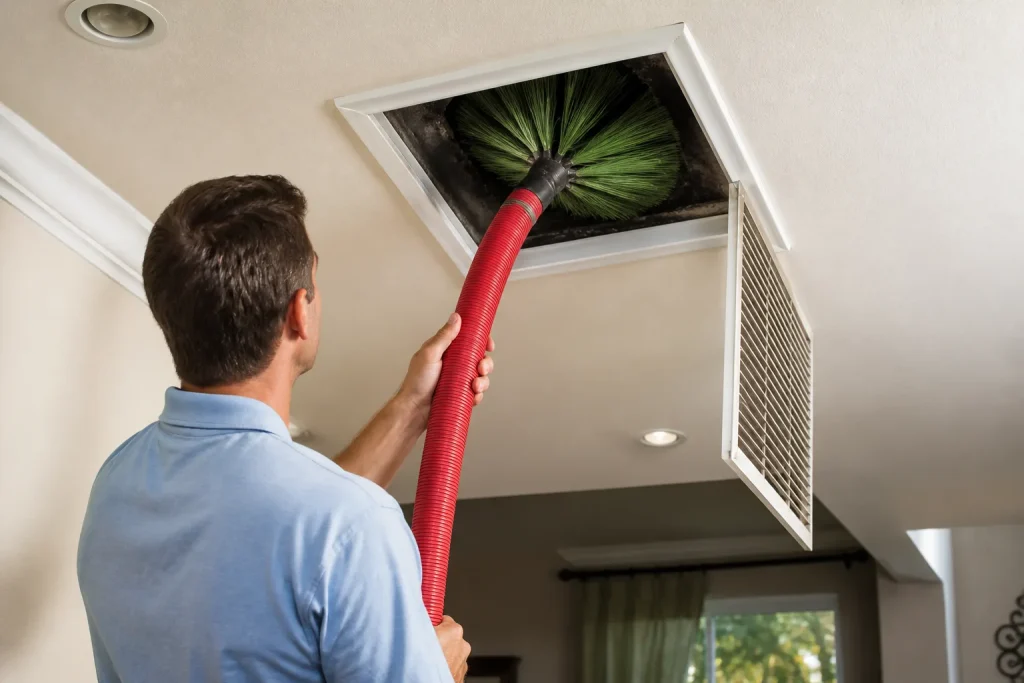
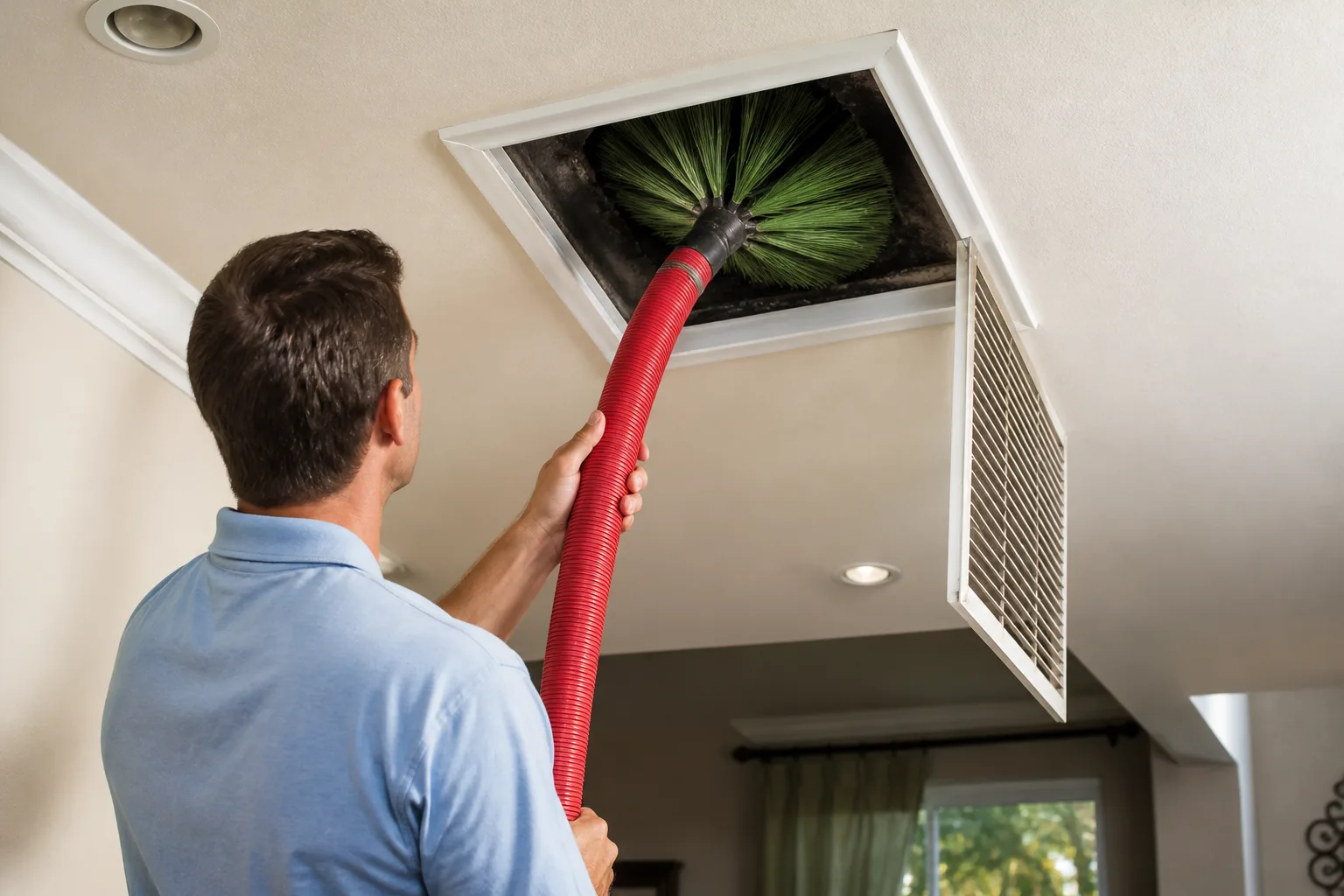
If your white cloth test comes back dark and the smell doesn’t go away, that’s likely a job for professional equipment. Consumer vacuums and shop vacs don’t have the containment or the reach, which is why we use Rotobrush and Nikro systems on every job rather than something you’d buy at a hardware store.
When to Call a Pro
Call us when a self-check turns up heavy buildup inside a return or supply run, when odor persists after the outdoor air is clear, or when a wind event leaves a fresh layer of dust returning indoors no matter how often you clean. Those are the situations where a professional-grade clean, paired with a check of the coil and the duct joints, actually resolves the issue.
Our technicians have up to 13 years of experience and use Abatement Technologies air-scrubbing equipment to keep contaminants contained during the work, then verify the result with before-and-after photos so you can see what changed. For air quality concerns beyond cleaning, we use Honeywell and Aprilaire products as part of a sanitizing treatment. We answer 24/7. Fast dispatch from 7am to 7pm, Sunday through Friday.
Related services in Anaheim Hills: If your ducts need cleaning, book air duct cleaning. If the problem is lint buildup in your laundry line, that’s dryer vent cleaning, a separate service worth scheduling at the same time.
The Bottom Line
Don’t trust a generic list. Match the symptom to the likely cause first. Dust on grilles usually means filtration. Uneven temperatures usually mean leakage or a restriction. Long run times and higher bills are late-stage signs that something has been quietly costing you for a while. Persistent odor, heavy buildup inside the ducts, and return-in-under-a-week dust after a wind event are the signs that genuinely point to duct contamination.
If you’re in Anaheim Hills and want an honest read on your system, Air Duct Cleaning Anaheim Hills offers free estimates and a flat price per system agreed before work starts. Call Air Duct Cleaning Anaheim Hills at (855) 526-8990 to get started.
Frequently Asked Questions
The signs that point to genuine duct contamination are persistent indoor odor that returns after venting, heavy dark buildup visible inside a return or supply run, and debris blowing from a register when the blower starts. Dust settling on the outside of a grille usually points to a filter problem instead, so rule that out first.
Not usually. Dust on the outer grille typically means your filter isn’t capturing particles efficiently, so they settle on nearby surfaces. Check the filter and airflow first, and look inside the register with a flashlight if you want a clearer signal. If it’s heavy, call (855) 526-8990 and we’ll help you decide.
It can help, but energy impact is usually a late-stage effect rather than an early one. Contamination restricts airflow gradually, and the system runs longer once airflow has dropped. If you’re already seeing longer run times, an inspection will tell you whether cleaning, sealing a leak, or a coil service is the real fix.
Sometimes, but not always. A musty smell that stays even when the system is off often points to a dirty evaporator coil or a moisture problem elsewhere in the HVAC unit. A proper inspection checks the coil and the system together before recommending a duct clean. Call (855) 526-8990 for a free estimate and we’ll walk you through it.
Written by the team at Air Duct Cleaning Anaheim Hills.
Need Air Duct Cleaning Help?
Call Air Duct Cleaning Anaheim Hills - the local pro we connect you with is licensed and insured, here with fast help in Anaheim Hills.
(855) 526-8990